
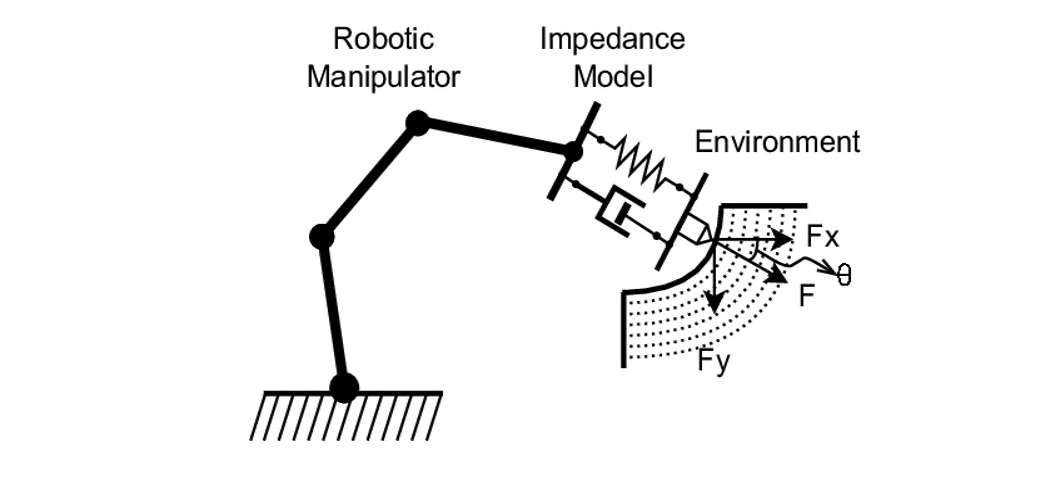
Industrial robots are traditionally designed for tasks that do not require physical contact with their environment. Because of this, most industrial robots rely on position control rather than force control. Torque-based impedance control is often difficult to apply in these systems because it requires an accurate dynamic model of the robot, which can be complex and hard to compute. To address this issue, this project uses position-based impedance control. This approach allows the robot to behave like a virtual mass–spring–damper system, enabling force tracking during contact tasks without explicitly deriving the robot’s dynamic model.
As robots are increasingly used in tasks that involve direct physical interaction, safe and accurate force control has become essential.
Force Tracking on an Even Surface
Position-based impedance control is implemented on a 3R planar robot to track contact force on a flat surface. The simulation starts with the robot operating in free space and then transitions into contact with the surface, as shown in the simulation video.
Force Tracking on an Uneven Surface
For uneven surfaces, the same control strategy is applied, but the environment stiffness changes over time. This allows the controller to adapt to variations in surface properties. The stiffness profile is defined as:
- Ke = 3500 N/m for 0 < t < 2.5 s
- Ke = 5000 N/m for 2.5 < t < 3 s
The simulation demonstrates stable force tracking under changing surface conditions.